
Product liability cases can become complicated quickly. Legal teams may need to work through medical records, scientific and technical evidence, product information, and regulatory requirements while managing the demands of a case.
While every case is different, most product liability lawsuits follow a similar process. Understanding the key stages can help legal teams anticipate important milestones, stay organized, and make informed decisions as the case progresses.
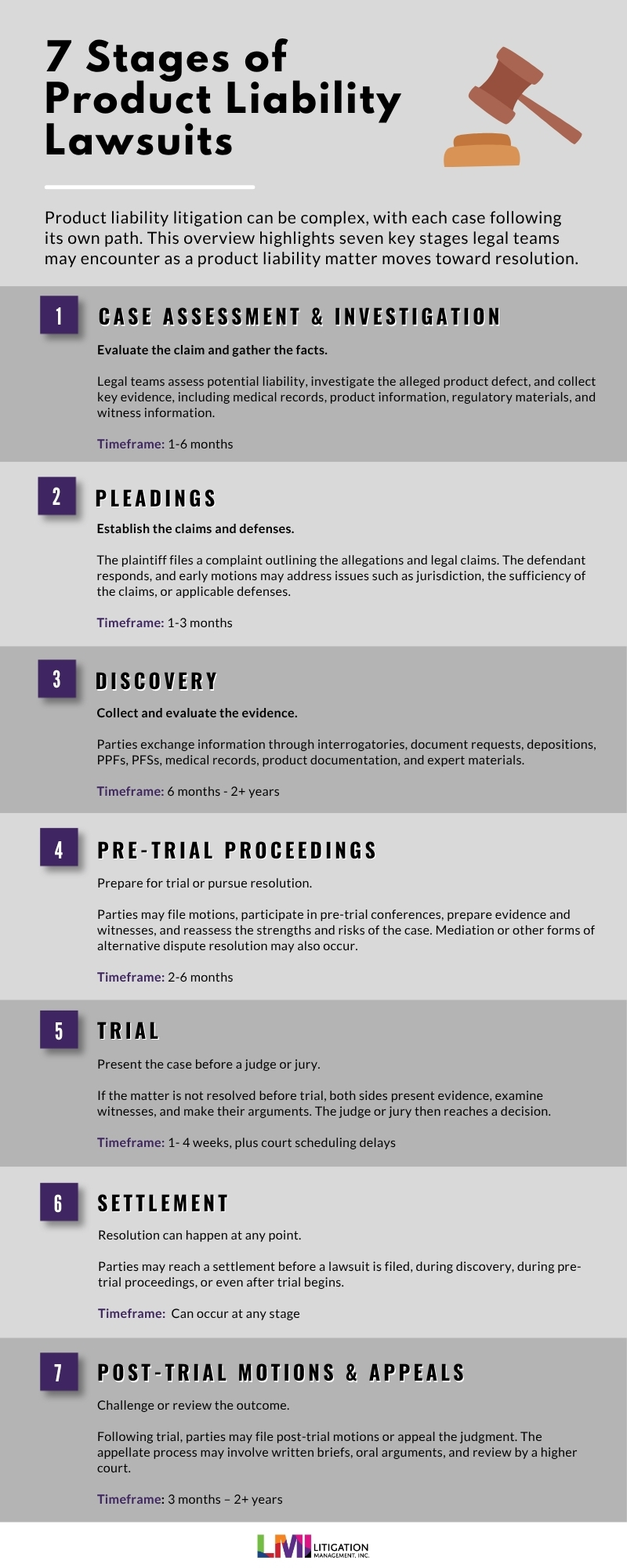
The infographic below provides a quick reference to the seven key stages of product liability litigation, followed by a closer look at what happens during each stage.
What is a Product Liability Lawsuit
A product liability lawsuit is a civil legal action in which a party seeks to hold a manufacturer, distributor, supplier, or retailer legally responsible for harm allegedly caused by a defective or unreasonably dangerous product.
The core allegation in a product liability case is that a product posed an unreasonable risk that led to injury, property damage, or other harm.
Product liability lawsuits span a wide range of industries and product types, from pharmaceuticals and consumer electronics to industrial machinery and automobiles. They’re handled in state and federal courts and often involve complex factual, scientific, and regulatory issues.
Product Liability Litigation Timeline
How long does product liability litigation take? The answer depends on the complexity of the matter, number of parties and claims, volume of discovery, court schedules, expert involvement, and whether the case settles before trial.
| Stage | Typical Timeline* |
|---|---|
| Case Assessment & Investigation | 1-6 months |
| Pleadings | 1-3 months |
| Discovery | 6 months-2+ years |
| Pre-Trial Proceedings | 2-6 months |
| Trial | 1-4 weeks, plus scheduling |
| Settlement | Can occur at any stage |
| Post-Trial Motions & Appeals | 3 months-2+ years |
*These timeframes are general estimates. Actual timelines vary significantly by jurisdiction, case complexity, and other factors.
1. Case Assessment & Investigation
Product liability litigation generally begins with case assessment and investigation. Legal teams evaluate the facts of a potential claim and determine whether the alleged harm may be connected to a product defect, including a design defect, manufacturing defect, or failure to warn.
This stage may involve collecting and reviewing:
- Product and manufacturing documentation
- Medical records
- Incident reports
- Regulatory information
- Expert input
- Witness information
- Prior claims or litigation
- Other evidence relevant to liability and damages
For defense counsel and corporate legal teams, early investigation may also involve assessing potential litigation exposure, identifying relevant documents and data, and coordinating information across multiple parties or locations.
Typical timeframe: 1–6 months
Early organization of case information can have a significant impact on the rest of the litigation. In complex matters, centralized data management can help legal teams identify trends, organize information, and make more informed decisions as the case develops.
2. Pleadings
Pleadings are the formal documents that establish the parties' claims and defenses.
A product liability lawsuit generally begins when the plaintiff files a complaint describing the allegations and legal claims. The defendant is then served and typically responds with an answer or a motion to dismiss. Early motion practice may address issues such as jurisdiction, the sufficiency of the pleadings, or applicable defenses.
Product liability litigation involving multiple plaintiffs with similar allegations may also develop into mass tort or multidistrict litigation (MDL). In these matters, courts and counsel may coordinate cases involving common questions of fact or law.
Typical timeframe: 1–3 months
Once the complaint is filed, the defendant typically has 21 to 30 days to respond, but the exact timeframe for responding to a complaint depends on the jurisdiction, method of service, and applicable rules. Motions filed during this stage can also extend the timeline.
3. Discovery
Discovery is the exchange of information and evidence between parties and is often the most resource-intensive stage of product liability litigation.
During discovery, each side gathers information needed to evaluate claims and defenses, prepare for trial, and assess opportunities for resolution. The types of information and documentation involved can vary depending on the case. In mass tort and product liability litigation, standardized claimant forms can also help organize information across large numbers of plaintiffs.
Discovery may include:
- Interrogatories: Written questions that require the opposing party to provide answers under oath.
- Requests for production: Formal requests for documents, records, electronically stored information, and other evidence relevant to the case.
- Requests for admission: Statements or facts that a party is asked to admit or deny, helping narrow the issues that need to be proven.
- Depositions: Formal interviews in which parties, witnesses, or experts provide sworn testimony outside of court.
- Plaintiff Profile Forms (PPFs): Structured forms used to collect standardized information about individual plaintiffs and their claims.
- Plaintiff Fact Sheets (PFSs): Court- or case-specific forms that collect information about plaintiffs, their alleged injuries, medical history, and other relevant facts.
- Census or claimant information: Data used to identify, organize, and track individuals involved in a mass tort or other large-scale litigation.
- Medical record collection and review: Gathering and analyzing medical records to understand a claimant's treatment history, diagnoses, injuries, and other relevant medical information.
- Product and manufacturing records: Documents that may provide information about product design, manufacturing, testing, warnings, quality control, and distribution.
- Expert reports and testimony: Opinions and supporting evidence from qualified experts regarding issues such as product design, causation, medical conditions, damages, or other technical matters.
In product liability and mass tort litigation, the volume and complexity of discovery can make data organization particularly important. Medical records, claimant information, product data, and other discovery materials may need to be collected, standardized, reviewed, and analyzed across large numbers of claims.
Effective discovery management helps legal teams identify key facts, evaluate causation and liability theories, identify gaps in the evidence, and prepare for settlement discussions and trial.
Typical timeframe: 6 months–2+ years
Discovery is often the longest stage of litigation. The timeline depends on the number of parties and claims, volume of documents, complexity of the issues, expert involvement, and court-imposed deadlines.
4. Pre-Trial Conference
Once discovery is substantially complete, the parties typically move into pre-trial proceedings. This stage may include motions for summary judgment, motions addressing evidence or trial issues, pre-trial conferences, and continued efforts to resolve some or all of the claims.
At this point, both sides may reassess the strengths and risks of the case based on the evidence developed during discovery. Some disputes may be resolved without going to trial through alternative dispute resolution (ADR), which provides ways for parties to reach an agreement outside of traditional courtroom proceedings.
Two common forms of ADR are mediation and arbitration.
- Mediation: Mediation involves a neutral third party who helps the parties work toward a mutually acceptable resolution. The mediator does not decide the outcome of the case.
- Arbitration: Arbitration involves presenting a dispute to an arbitrator rather than a judge. Depending on the agreement and circumstances, the arbitrator's decision may be binding or non-binding.
Typical timeframe: 2–6 months
The timing of pre-trial proceedings varies based on court schedules, pending motions, settlement discussions, and the complexity of the matter.
5. Trial
If the case is not resolved before trial, the parties present their evidence and arguments before a judge or jury. It can take years to go to trial.
Product liability trials can involve complex scientific and technical evidence, expert testimony, medical records, product documentation, and evidence related to defect, causation, and damages.
Generally, the plaintiff presents evidence supporting the claims first, followed by the defense. After both sides have presented their cases, the judge or jury reaches a decision.
Typical timeframe: 1–4 weeks, plus court scheduling
The trial itself may last from several days to several weeks. However, securing a trial date can take considerably longer depending on the court and complexity of the case.
6. Settlement
Settlement is not limited to one stage of product liability litigation. Parties can reach a settlement before a lawsuit is filed, during discovery, during pre-trial proceedings, or even after a trial has begun.
Settlement discussions may become more active as the parties develop a clearer understanding of the evidence and potential risks involved.
Factors that may influence settlement decisions include:
- Strength of the evidence
- Potential liability and damages
- Results of discovery
- Expert opinions
- Insurance coverage and policy limits
- Number and severity of claims
- MDL or mass tort status
- Litigation costs
- Court or mediator involvement
Typical timeframe: Can occur at any stage
There is no standard timeline for settlement. In many cases, parties have a better understanding of the risks and potential value of a matter after significant discovery has been completed.
7. Post-Trial Motions & Appeal
Following a trial, the parties may pursue post-trial motions or an appeal.
Post-trial motions may seek a new trial or challenge aspects of the judgment. Either party may also appeal a trial court decision based on alleged legal or procedural errors.
Product liability appeals may address issues such as:
- Expert testimony and admissibility
- Jury instructions
- Evidentiary rulings
- Interpretation of statutes or regulations
- Legal standards related to product liability claims
Appeals are subject to strict filing deadlines, which vary depending on the jurisdiction and circumstances of the case.
Typical timeframe: 3 months–2+ years
The appellate process can include briefing, oral arguments, and review by the appellate court. Depending on the case, the process can take a year or longer.
How Long Does Product Liability Litigation Take?
There is no standard timeline for a product liability lawsuit. A straightforward case may resolve relatively quickly, while complex litigation involving multiple plaintiffs, defendants, experts, and large volumes of discovery can take several years.
Factors that can affect the product liability litigation timeline include:
- Number of plaintiffs and defendants
- Complexity of the alleged product defect
- Volume of medical and discovery records
- Number of claims involved
- Expert testimony and scientific evidence
- Court schedules and deadlines
- Discovery disputes
- Motion practice
- Settlement negotiations
- Whether the litigation involves an MDL or mass tort
Because litigation generates new information at every stage, maintaining organized and accessible case data is important from the initial investigation through resolution.
Frequently Asked Questions About Product Liability Litigation
What are the seven stages of product liability litigation?
The seven key stages are case assessment and investigation, pleadings, discovery, pre-trial proceedings, trial, settlement, and post-trial motions and appeals. Settlement can occur at any point throughout the litigation process.
How long does a product liability lawsuit take?
The timeline varies depending on the complexity of the case. Product liability litigation can take several months to several years, particularly when a matter involves multiple plaintiffs, extensive discovery, expert testimony, or an MDL.
What happens during discovery in a product liability case?
During discovery, parties exchange information and evidence relevant to the claims and defenses. This may include interrogatories, document requests, depositions, plaintiff fact sheets, medical records, product information, and expert materials.
Can a product liability case settle before trial?
Yes. A product liability case can settle at any point, including before a lawsuit is filed, during discovery, during pre-trial proceedings, or after trial begins.
What happens after a product liability trial?
After a trial, the parties may file post-trial motions or appeal the judgment. The appellate process can involve written briefs, oral arguments, and review by a higher court.
How does medical record review support product liability litigation?
Medical record review can help legal teams organize and analyze treatment history, diagnoses, injuries, medications, procedures, and other medical information relevant to a claim. In complex litigation, standardized medical data and timelines can also make it easier to evaluate trends across multiple claims.
Managing Data Throughout Product Liability Litigation
Each stage of product liability litigation can generate significant amounts of information. Medical records, claimant data, discovery documents, product information, expert materials, and case activity may need to be collected and organized across a large number of claims.
A centralized approach to legal data management can help legal teams maintain consistent information, streamline discovery workflows, identify trends, and access the information needed to support case strategy.
Medical records can be particularly important in product liability and mass tort matters. Organizing records and developing clear medical timelines can help legal teams evaluate injuries, treatment history, causation, and other factors relevant to individual claims.
LMI supports legal teams throughout the litigation lifecycle with medical record retrieval and review, legal data management, case management, data analytics, and litigation support. Technology-enabled solutions can help organize complex information so legal teams can spend less time managing data and more time using it to move matters forward.