

Why Early Case Decision-Making Has Always Been Difficult
Long before the adoption of Federal Rule of Civil Procedure 16.1, litigators and in-house legal teams were already navigating a familiar set of challenges at the outset of complex matters. Early in a case, parties are often asked to make meaningful decisions about discovery scope, timing, and strategy with limited visibility into the underlying information. The challenge between the need for speed and the need for insight has long shaped early case management discussions.
Rule 16.1 formalizes many of these expectations, emphasizing earlier engagement, clearer discovery planning, and appropriate scope. The rule suggests a structured framework for early case conferences, but the underlying challenges it addresses are not new.
Case Study: Early Case Management Before Rule 16.1
The following case study predates Rule 16.1, but it reflects how litigation teams were already adapting their approaches to early case assessment in response to growing complexity and information volume.
Environmental Litigation Case Study: Managing 14,000 Plaintiffs and Complex Claims
Matter type: Environmental
Allegations included:
- Personal injury
- Need for medical monitoring
- Property damage
- Other economic losses
The matter involved approximately 14,000 plaintiffs, each required to submit plaintiff fact sheets and supporting documentation. The case presented significant logistical and analytical complexity, including the collection of plaintiff fact sheet data, medical record retrieval, medical record review, and reporting tied to specific claim categories.
At the outset, the primary challenge was operational as much as legal: creating a streamlined vehicle to manage large-scale data collection and review while maintaining visibility into claim trends and categories. Decisions regarding discovery planning and case strategy needed to be made early, despite the volume of claimants and variability in supporting documentation.
Approaches to Early Case Decision-Making in Complex Matters
Rather than approaching each component separately, a centralized, structured solution was implemented. A single data platform was used to manage:
- Collection of plaintiff fact sheet data
- Medical record retrieval and organization
- Medical record review and analysis
- Reporting and analytics tied to four distinct categories of claims
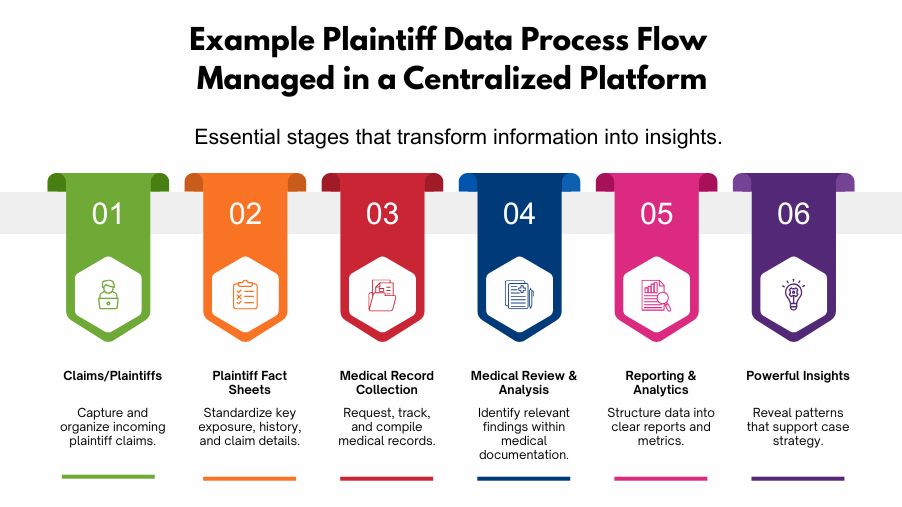
By consolidating these processes within one platform, the team was able to create consistency in intake, documentation, review protocols, and reporting. The approach was not designed to resolve the merits of each claim at the outset, but rather to establish an organized, transparent framework for understanding the scope and characteristics of the litigation.
This centralized structure allowed information to be tracked, categorized, and analyzed as it was received, rather than waiting for later stages of discovery to reveal trends.
What Early Review Revealed About Discovery Scope
As data collection and review progressed, the team was able to:
- Identify trends within specific claim categories
- Monitor completeness and compliance with plaintiff fact sheet requirements
- Track medical record retrieval status across the claimant population
- Generate reporting tied to personal injury, medical monitoring, property damage, and economic loss allegations
The centralized reporting and analytics provided visibility into how claims were developing across all four categories, allowing stakeholders to make informed decisions about scope, prioritization, and allocation of resources.
Results of the approach |
| Saved nearly 27k hours, reducing time spent by 34% |
| Reduced legal expenses by 66% through streamlined data management |
| Reduced legal expenses over $4M in four years |
These outcomes supported more structured discussions around discovery planning and case management, even before Rule 16.1 was in place.
The Evolution of Early Case Management and Rule 16.1
Since this case took place, Rule 16.1 has suggested a more structured framework for early case management discussions. The rule reflects an increased judicial focus on:
- Defining discovery scope early
- Focusing on what’s necessary and relevant
- Clarifying how discovery will be conducted
The approach taken in this environmental matter aligns with several of the considerations now reflected in Rule 16.1. Centralized data management, early visibility into claim categories, and structured reporting are consistent with the type of informed early discussions the rule now encourages.
What Has Remained Consistent in Early Case Management
What this case study illustrates is not a shift in objectives, but consistency in approach. Whether before or after Rule 16.1, effective early case management depends on:
- Establishing organized systems for large-scale information collection
- Gaining early visibility into key data sets
- Structuring review processes around clearly defined claim categories
- Supporting discovery planning with documented analytics and reporting
Key Takeaways for Early Case Management Under Rule 16.1
While procedural rules evolve, the challenge remains: turning data into actionable insight early enough to inform meaningful case management discussions. This case demonstrates how centralized data structures and early analytics can help:
- Inform discovery planning across large claimant sets
- Provide structured, evidence-based insights for stakeholders
- Translate raw information into actionable decisions
Experienced Support for Complex Litigation and Early Case Planning
For more than 40 years, we have partnered with legal teams to bring structure and clarity to complex matters. If your team is assessing how to streamline data collection, medical record review, and reporting, we would be glad to share insights specific to your needs.