
Data plays a central role in today’s product liability litigation. Legal teams are increasingly expected to make informed decisions earlier in the litigation process, often before every record has been collected or every fact has been verified.
Mass torts and multidistrict litigations (MDLs) have amplified this challenge. Product claims frequently involve years of medical treatment, multiple healthcare providers, complex product histories, and evolving regulatory information. Early case assessment is no longer just about determining whether a case has merit. It is about organizing information, identifying risks, and creating a foundation for strategic decision-making.
Becoming data-ready early gives legal teams a stronger foundation for evaluating claims and shaping case strategy.
The Role of Early Case Assessment in Product Liability Litigation
The earliest stages of a product claim can significantly influence the efficiency and outcome of a case. Before substantial resources are invested, attorneys must begin answering important questions:
- Is there sufficient evidence to support the claim or defense?
- Are key medical records available?
- Does the timeline support or weaken the case?
- Are there statute of limitations concerns?
- Does the claimant's medical history align with the alleged injury?
- How does this claim compare to others in the litigation?
As product liability litigation grows in complexity, these answers can depend on how quickly information can be collected, organized, and analyzed.
Today's Product Claims Require a Data-First Approach
One trend becoming more apparent across product liability litigation is the growing emphasis on evaluating claims before committing significant resources.
Rather than waiting until discovery is well underway, many legal teams are assembling structured case data much earlier to identify patterns, evaluate exposure, and prioritize claims. In large litigations, this information can help determine which cases warrant additional investment, which require further investigation, and which may present procedural or evidentiary challenges.
Even seemingly straightforward details can have a significant impact. For example:
- Dates of product use may affect statute of limitations analyses.
- Treatment timelines can help establish or challenge causation.
- Prior medical conditions may become relevant during claim evaluation.
- Gaps in treatment or missing documentation can identify additional record retrieval needs.
The earlier this information is available, the more informed the legal strategy becomes.
6 Steps to Building an Early Case Assessment Workflow
Effective early case assessment is not a single task. It is a series of connected steps that transform scattered information into actionable intelligence. By establishing a structured workflow, legal teams can move from collecting information to evaluating claims with greater efficiency and confidence.
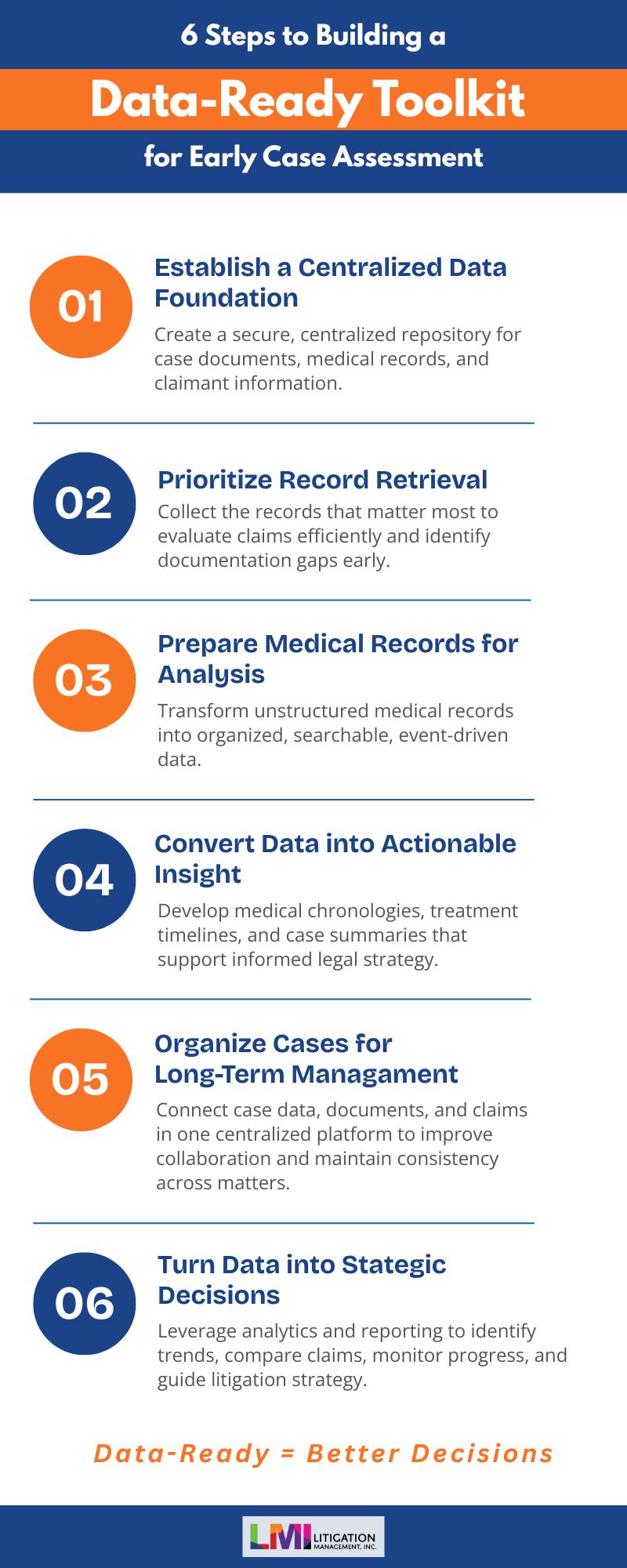
Step 1: Establish a Centralized Data Foundation
Every case begins with information arriving from multiple sources.
Medical records, claimant information, product details, provider documentation, and supporting evidence often exist in different formats and locations. Creating a centralized repository allows legal teams to organize data consistently from the outset.
A legal data management platform provides the structure needed to securely store documents, standardize information, and prepare data for downstream analysis.
Step 2: Prioritize Record Retrieval
Case strategy is only as strong as the underlying documentation.
Identifying which records are necessary and obtaining them efficiently helps reduce delays while ensuring attorneys have the information needed to evaluate a claim. Early retrieval efforts can also reveal missing providers, incomplete treatment histories, or documentation gaps that should be addressed before litigation progresses.
Rather than requesting every possible record immediately, prioritize retrieving the records most critical to early decision-making.
Step 3: Prepare Medical Records for Analysis
Once records have been collected, the next challenge is making them usable.
Medical records often arrive from multiple providers in different formats, with duplicate documents, inconsistent organization, and varying levels of completeness. Before meaningful analysis can begin, that information must be organized into a structured, searchable format.
Medical record data management transforms unstructured records into event-driven datasets that organize key clinical events, treatment histories, and supporting documentation. This structured approach helps legal teams locate critical information more efficiently, identify potential gaps in the record, and establish a stronger foundation for medical review and case strategy.
Step 4: Convert Medical Records into Actionable Insight
With records organized and structured, medical record review becomes significantly more efficient.
The review process can produce medical chronologies, treatment timelines, narrative summaries, and issue-specific analyses that help legal teams quickly understand the progression of care, identify significant medical events, evaluate alleged injuries, and connect clinical findings to the facts of the case.
Rather than spending valuable time reviewing thousands of pages of medical records, attorneys can focus on the information most relevant to evaluating claims and developing legal strategy.
Step 5: Organize the Case for Long-Term Management
As litigation expands, consistency becomes increasingly important.
Case management processes help standardize workflows, monitor case status, track outstanding documentation, and maintain visibility across growing inventories of claims. This becomes particularly valuable when multiple stakeholders are collaborating across large litigation portfolios.
A centralized, customizable case and claims management platform allows legal teams to securely store and share case data and documents while connecting information across individual claims, related matters, and broader litigation portfolios. Having a single source of truth helps reduce duplicate efforts, improves collaboration, and ensures teams are working from consistent, up-to-date information throughout the lifecycle of a case.
Organized case management also creates a strong foundation for reporting and portfolio-level analysis as litigation evolves.
Step 6: Turn Case Data into Strategic Insight
Collecting and organizing information is only part of the process.
Analytics and reporting empower legal teams to identify trends across individual cases or entire portfolios. Dashboards and reporting can help attorneys evaluate:
- Claim characteristics
- Treatment patterns
- Provider trends
- Record completion status
- Timeline milestones
- Portfolio-level metrics
These insights support more informed discussions around case strategy, resource allocation, and litigation planning.
Building a Product Liability Toolkit for Early Case Assessment
Effective early case assessment isn't built around a single technology or service. It depends on using the right tools at the right stage of the process.
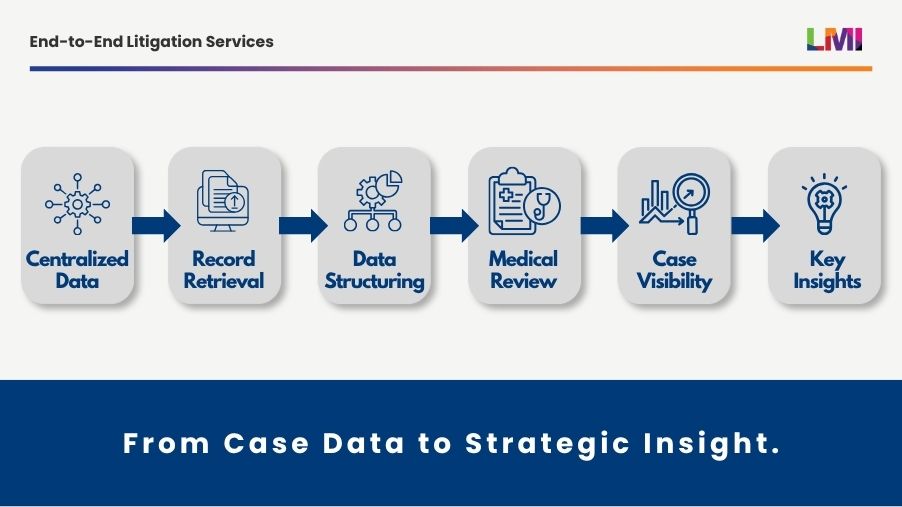
Legal data management creates a centralized foundation for case information. Record retrieval ensures the documentation needed to evaluate a claim is available. Medical record data management organizes and structures that information so it can be analyzed efficiently. Medical record review transforms the data into meaningful insights through chronologies, treatment timelines, and issue-focused analyses. Case management keeps claims organized and connected as litigation grows.
Throughout the process, analytics and reporting help bring the data together. By transforming information from individual claims into meaningful insights, legal teams can identify trends, compare cases, monitor progress, and make more informed decisions about case strategy and resource allocation. This becomes particularly valuable in large product liability matters and MDLs, where consistent, structured data can help attorneys evaluate claims across an entire litigation rather than one case at a time.
Together, these capabilities create a connected, data-ready workflow that supports informed decision-making from intake through resolution. Instead of simply collecting information, legal teams are better positioned to uncover patterns, evaluate claims with greater confidence, and adapt their strategy as litigation evolves.
Building Strategy from Day One
Product liability litigation will always continue to evolve. Cases involve larger volumes of information, greater medical complexity, new technologies, and increased pressure to evaluate claims quickly and within budget.
Legal teams that engage the right resources early are better positioned to identify risks, uncover opportunities, and make informed decisions throughout the litigation process.
Rather than viewing early case assessment as a single checkpoint, consider it an ongoing strategy. Building a data-ready foundation at the beginning of a matter helps support stronger analysis, more efficient workflows, and better-informed decision-making as each case progresses.
Ready to strengthen your early case assessment process? Partner with a legal support team that can help organize data, streamline workflows, and provide strategic insight from the earliest stages of litigation through case resolution.