
September 28, 2026
Artificial intelligence is moving quickly, and medical record review is no exception.
Across the legal industry, AI is being used to process medical records, identify information, summarize documents, and organize large volumes of data. New tools and capabilities are emerging all the time, including technology designed to create medical chronologies.
At LMI, we are paying close attention. More than that, we are actively exploring and testing how AI can improve medical record review.
We believe AI has an important role to play in the future of medical review. It can create efficiencies, reduce the time spent on repetitive tasks, and reduce costs for legal teams.
But there is also a lot of noise around what AI can do today.
So, let's separate what is possible now from what may be possible next.
What is an AI Medical Chronology?
One of the areas where AI can already be useful is organizing medical records.
AI can process large volumes of records and identify information such as dates, providers, diagnoses, procedures, medications, and other medical events. It can then use that information to place events in chronological order.
That can be incredibly valuable.
Anyone who has worked with a large medical record inventory knows that simply getting hundreds or thousands of pages organized into a usable timeline can take significant effort and time. Technology that can assist with that process creates an opportunity for greater efficiency.
But chronological organization is only one part of a medical chronology.
That distinction is important.
AI is already changing the way medical records are processed, and we see tremendous potential in where the technology is headed. Our position is not to resist that change, but to understand it. We are actively testing AI capabilities so we can distinguish between what the technology can do today and what it may be capable of tomorrow. Our clients deserve that clarity, and we intend to provide it. - Sonya Virant, CEO, LMI
AI Medical Chronologies: Organization vs. Medical Analysis
A medical chronology prepared for an attorney is more than a collection of medical events arranged by date. A nurse reviewing the records brings clinical knowledge and context to the process, identifying relationships between events, recognizing patterns, and evaluating the significance of the information in the record.
For example, a nurse may recognize:
- A change in symptoms following an injury or procedure
- A progression or pattern in a patient's condition
- The relationship between a diagnosis and subsequent treatment
- Gaps or inconsistencies in the medical records
- Changes in medications or treatment plans
- The significance of a diagnostic finding in the context of the patient's broader history
- Pre-existing conditions that may be relevant to understanding later medical events
That is medical analysis. It requires more than identifying what happened and when it happened. It requires understanding what the medical information means in context.
This is where some of the terminology surrounding AI chronologies can become confusing. An "AI chronology" may use artificial intelligence to extract information from medical records and organize medical events chronologically. That can be useful, particularly when working with large volumes of records.
However, an electronically organized timeline is not the same as a chronology that includes clinical analysis performed by a nurse.
AI can organize the events. A nurse can analyze the events.
Today, those are different capabilities.
AI-Assisted Organization | Nurse Medical Analysis |
|---|---|
| Organizes medical records chronologically | Interprets the clinical significance of medical events |
| Extracts and presents documented medical events | Connects events to identify patterns and relationships |
| Identifies diagnoses, procedures, medications, and other documented information | Evaluates how diagnoses, treatments, symptoms and medications relate to one another |
| Processes large volumes of records efficiently | Looks beyond documented events to identify clinically significant details, gaps, inconsistencies, and information that may be missing from the record |
| Reduces time spent on repetitive organizational tasks | Applies clinical judgment to gaps, inconsistencies, and other findings |
| Supports efficiency and can help reduce review costs | Helps legal teams understand the medical story within the record |
The distinction is not intended to diminish the value of AI. In fact, it highlights where AI can provide the most value. By handling time-consuming organizational tasks, AI can help make medical record review more efficient while allowing qualified medical professionals to focus on interpretation and analysis.
The question is not whether AI belongs in medical review. It does.
The question is where AI can add value today, and where human clinical judgment is still needed.
We are seeing AI do some impressive things when it comes to processing and organizing medical records. But there is an important difference between identifying and organizing medical events and understanding their clinical significance. That distinction comes up consistently in our conversations with clients. We are testing these technologies ourselves, and we want our clients to have a clear understanding of where AI can create value today, while keeping an eye on where it is going next. – Maria Petruccio, Chief Innovation and Client Success Officer
How AI and Nurses Can Work Together in Medical Record Review
We see the future of medical review as a combination of technology and human knowledge, not a competition between the two.
AI can take on time-consuming, repetitive work. It can help process and organize information quickly, allowing nurses to spend more of their time on higher-value review and analysis.
That creates an opportunity to improve efficiency without sacrificing the clinical perspective that makes a medical chronology useful to an attorney.
And as AI continues to develop, that balance will continue to change.
Today's technology may be capable of organizing medical events. Tomorrow's technology may be capable of much more.
What Does the Future of AI Medical Review Look Like?
This is the part we are watching closely.
AI capabilities are advancing rapidly. What seems out of reach today may become possible sooner than expected.
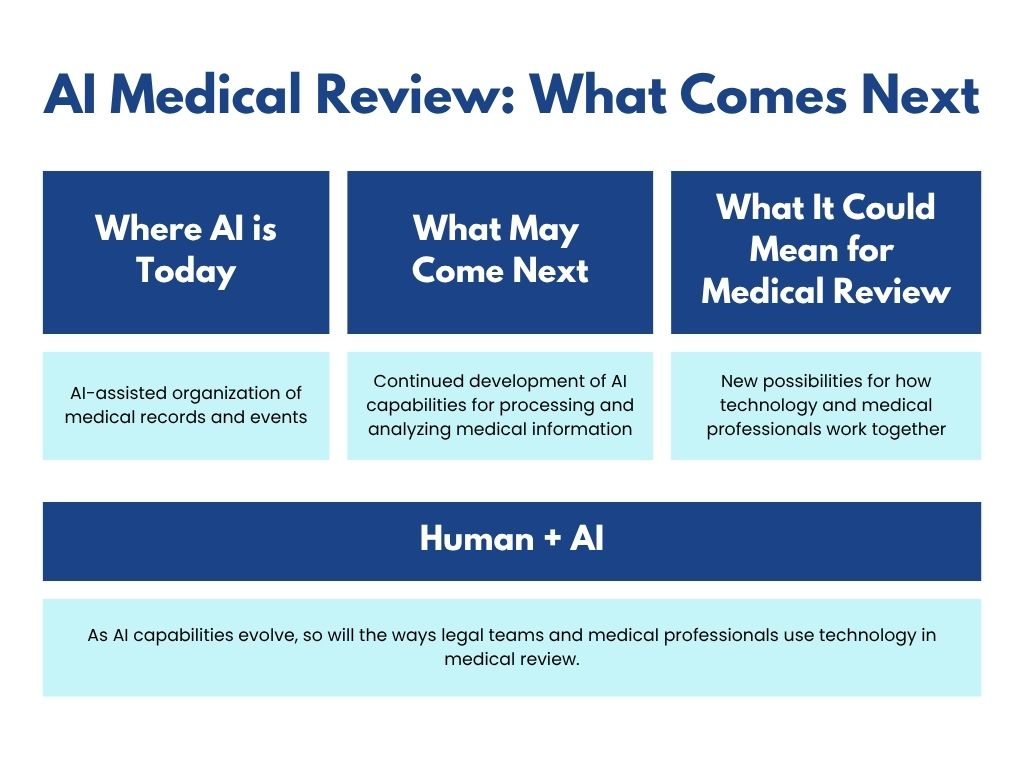
Could AI eventually perform meaningful medical analysis? We cannot say exactly when or what that will look like. But we are not waiting for it to happen before we start paying attention.
At LMI, we are actively evaluating AI developments, testing emerging capabilities, and looking at how they perform in real-world medical record review. We are also listening to feedback from our clients about where technology is creating value and where they still need the perspective of a medical professional.
Our approach is simple: embrace the technology, understand its capabilities, and be honest about where it stands today.
We will continue testing and evaluating as those capabilities evolve.
When AI reaches the point where it can perform meaningful medical analysis that meets the needs of legal teams, we intend to be among the first to know.
More importantly, our clients will be among the first to know.
Ultimately, the goal isn't to resist what's next. It's to understand what's next, know what is possible today, and use the technology responsibly to make medical review better.